
Published · August 20, 2026
Herringbone vs Straight-Plank Flooring: Which Should You Stock?
For a flooring retailer or distributor, herringbone vs straight-plank flooring isn't really a style question — it's a range-planning question. The two formats attract different customers, need different installation skills, and carry different SKU and inventory implications. Getting the mix wrong means either a showroom that looks like everyone else's, or a premium display nobody's asking for.
This guide covers what actually differs between the two formats — construction, installation, and stocking considerations — using Hawkline's own straight-plank and herringbone collections as concrete reference points, plus what the wear-class and water-resistance numbers on a spec sheet actually mean when you're deciding what to range.
Key Takeaways
- Straight-plank and herringbone are laying patterns, not durability categories — the construction (wear layer, wear class, core type) determines performance, and both formats span the same range of specs.
- Herringbone typically costs more to install than straight plank because of pattern layout time and higher cutting waste, not because the flooring material itself is inherently pricier.
- Hawkline's Mercury collection uses standard rectangular planks (127×635mm, click-lock) — it is not a herringbone or Chevron product, despite sometimes being lumped in with pattern flooring in general industry discussion.
- Wear Class 42 (ISO 10874) means a product is rated for heavy residential and general commercial traffic — it's a use-intensity classification, not a synonym for scratch resistance.
| Factor | Straight-Plank | Herringbone |
|---|---|---|
| Typical installation | Click-lock or glue-down | Glue-down (see our click-lock guide for the click-system exception) |
| Layout planning | Minimal — mostly wall-to-wall runs | Requires a checked center-line start |
| Typical cutting waste | ~5% | ~10%, more at diagonal walls |
| Hawkline collections | Treasure Lakes, Sky Painted, Mercury, Flex Planks | Flex Herringbone |
| Wear class range in-catalog | 33–42 | 42 |
| Showroom role | Broad range coverage, familiar to most buyers | Design-led differentiator |
What Straight-Plank Flooring Actually Covers
"Straight-plank" just means the planks run in parallel rows rather than an angled repeating pattern — it says nothing about construction, thickness, or installation system on its own. Hawkline's straight-plank range spans several different specs:
- Treasure Lakes — 7mm total thickness, 0.5mm wear layer, wear class 33, uniclic click installation, 230×1520mm planks.
- Sky Painted — 7mm total thickness, 0.75mm wear layer, wear class 42, uniclic click, 235×830mm planks.
- Mercury — 5mm/7mm total thickness, 0.75mm wear layer, wear class 42, uniclic click, 127×635mm planks. Despite occasionally being grouped with pattern flooring in general market discussion, Mercury is a standard rectangular-plank product, not a herringbone or Chevron collection.
- Flex Planks — 2.5mm total thickness, 0.55mm wear layer, wear class 42, glue-down, 188×1228mm planks.
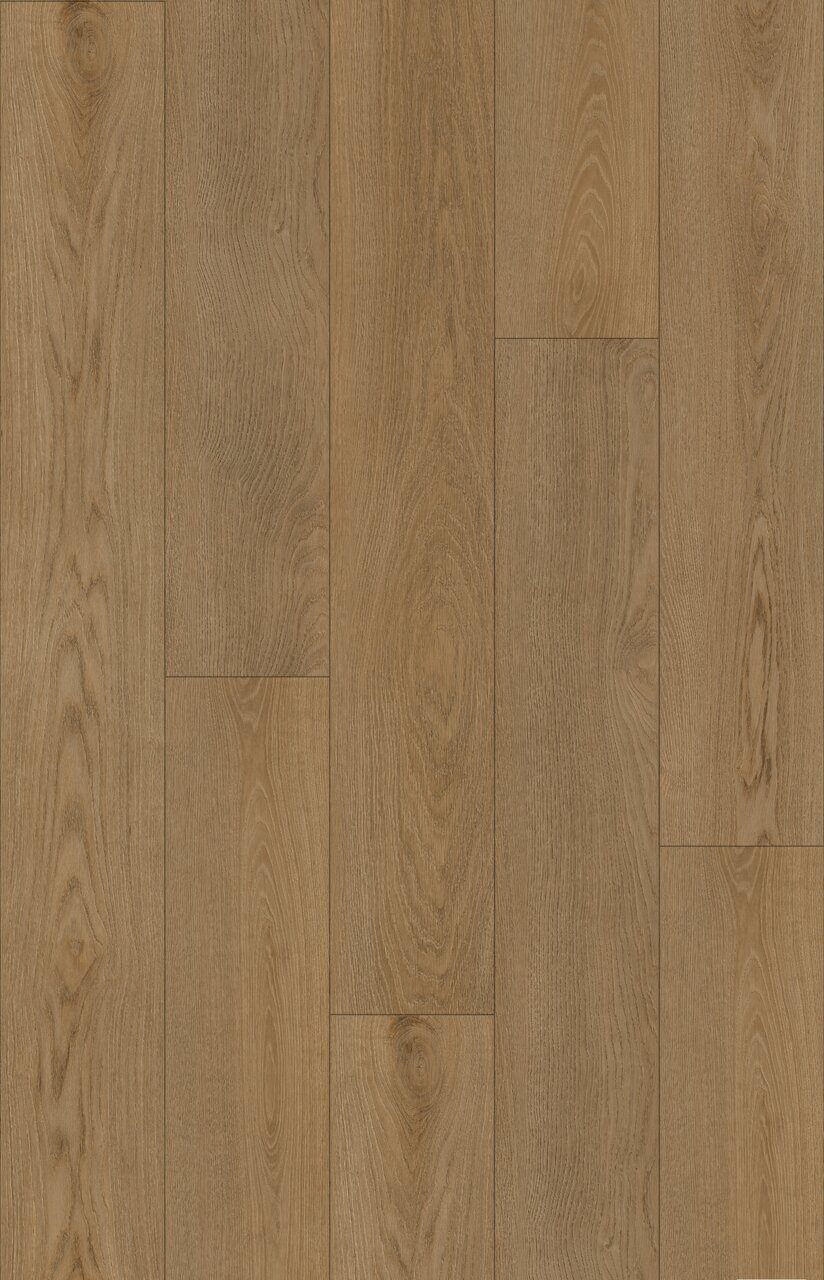
The spread of wear classes and thicknesses across just four straight-plank collections is the point worth taking away: "straight plank" tells a buyer almost nothing about durability or install method. The spec sheet does that, not the layout pattern.
What Herringbone Actually Is — And What It Isn't
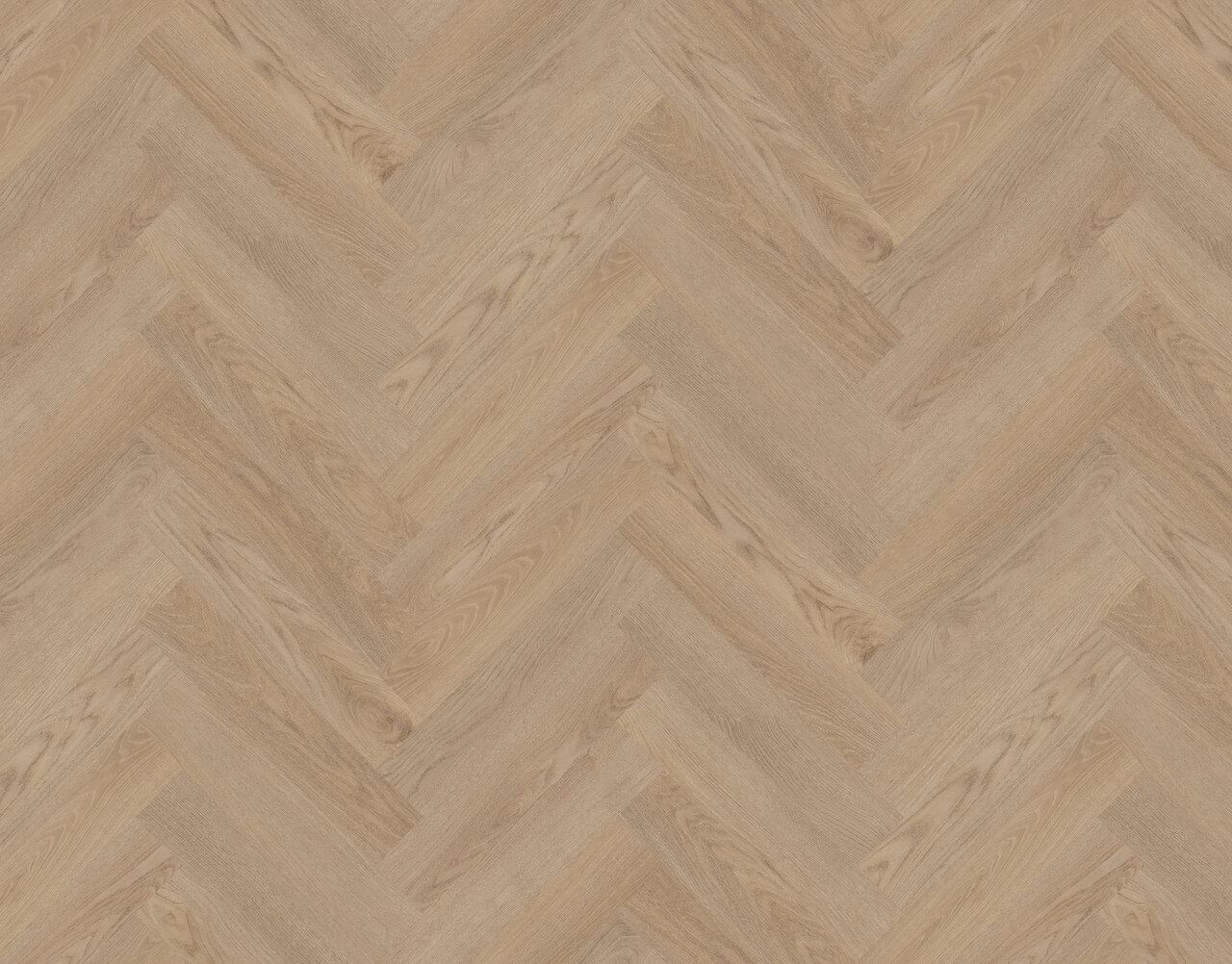
Herringbone lays rectangular planks at 90-degree angles to each other so each row zigzags into the next. It's worth distinguishing it from a related but different pattern retailers are often asked about:
- English herringbone — the traditional zig-zag, built from straight-edged rectangular planks.
- French herringbone (Chevron) — planks are pre-cut at an angle so they meet edge-to-edge in a continuous V, rather than the stepped zig-zag of English herringbone.
Both create a geometric look, but they're different products with different cutting requirements — a Chevron plank can't be substituted with an English-herringbone plank and vice versa. This matters at the point of sale because customers frequently use "herringbone" and "Chevron" interchangeably when describing what they want.
Hawkline's current herringbone offer — Flex Herringbone (122×610mm, 2.5mm total thickness, 0.55mm wear layer, wear class 42, glue-down, four decors) — is an English herringbone product. We don't currently stock a Chevron collection, so a customer specifically asking for Chevron needs to be told that up front rather than sold Flex Herringbone as a substitute.
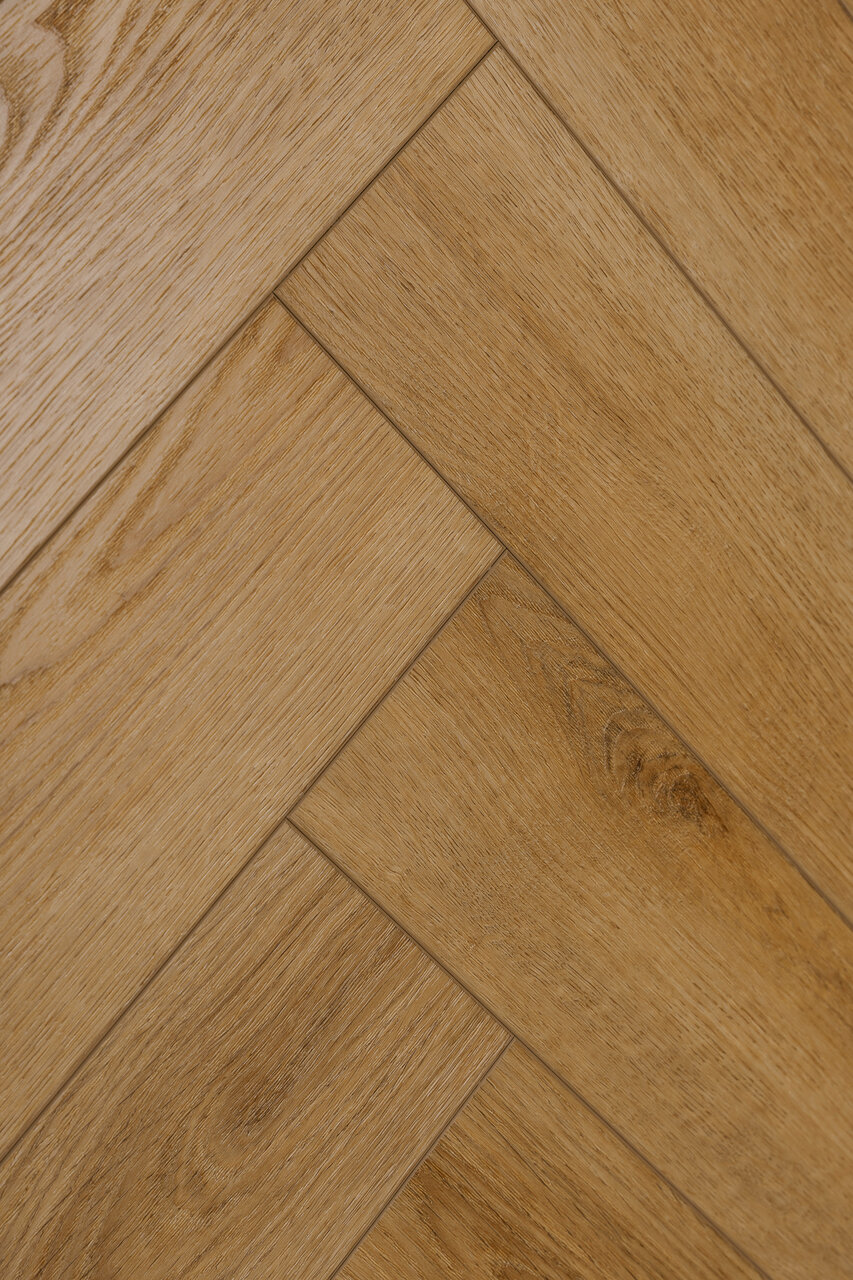
For a full breakdown of Flex Herringbone's spec sheet and buying considerations, see our SPC Herringbone Buyer's Guide.
Installation: Where the Real Cost Difference Sits
Comparing herringbone and straight plank on price per square metre alone misses the bigger cost driver: installed cost.
Herringbone has far more seams per square metre than straight plank — every plank touches four or more neighbors instead of two — which is why it's typically installed glue-down rather than clicked: gluing locks each piece individually so the pattern doesn't drift. (Click-lock herringbone systems do exist — see our installation guide for click-lock SPC herringbone for how those work — but they remain a smaller share of the herringbone market than glue-down.)
That translates into three real cost drivers retailers should flag to customers and contractors:
- Layout time. Herringbone needs a checked, squared center-line start before any plank is locked permanently — straight plank generally doesn't.
- Cutting waste. Herringbone commonly runs closer to 10% waste versus roughly 5% for straight-plank layouts, because of the diagonal cuts at every wall and doorway.
- Labor time. Full-spread adhesive installation with a pattern layout takes longer per square metre than clicking long planks together.
None of this means herringbone is a worse product — it means the total project cost needs to account for installation, not just the box price.
Construction Matters More Than the Pattern
The pattern a plank is cut into has no bearing on how durable or water-resistant the finished floor is. That comes down to the construction, and it's worth reading past the marketing photo to the actual spec sheet:
- Wear layer thickness — the clear protective film on top; thicker generally means longer resistance to scuffs and scratches.
- Wear class — classified under ISO 10874, the international standard for resilient, textile, and laminate floor coverings, which rates products by area and intensity of use rather than by a single "durability" score (ISO 10874:2009). A wear class 42 rating means a product is suited to heavy residential and general commercial traffic — it says nothing about water resistance or installation method on its own.
- Water resistance — check the individual product's documentation rather than assuming every SPC product carries the same rating. Hawkline lists both Flex Herringbone and its straight-plank collections as waterproof per their technical data sheets, but this is a per-product spec, not a blanket category claim.
- Underfloor-heating compatibility — also product-specific; confirm it on the spec sheet before quoting a project with heated subfloors.
For thermoplastic resilient floor coverings specifically, ISO 19322:2018 covers characteristics and marking requirements alongside the use-intensity classification (ISO 19322:2018). Retailers working with EU-market construction products more broadly can also reference the European Commission's overview of the Construction Products Regulation for the harmonised technical-performance framework these classifications sit within.
Stocking Strategy: Coverage vs Differentiation
Rather than asking which format "sells better" — a claim that depends entirely on local demand, showroom positioning, and customer mix and can't be answered in general — it's more useful to ask what role each format plays in a range.
Straight plank tends to work as range coverage: it's the format most customers already expect, it fits new-build and renovation projects at scale, and it's usually faster and cheaper to quote installation for. A showroom without a solid straight-plank base is missing the bulk of everyday demand.
Herringbone tends to work as a differentiator: it's the format that makes a showroom visit memorable and gives design-led customers — character-property renovations, boutique hospitality, apartments where the floor is meant to be a feature — a reason to choose one retailer over another stocking only straight plank.
Both roles matter in a balanced range. The practical way to size each category isn't a generic industry statistic — it's your own enquiry, quote, and order data by format, tracked over a few months, since local demand in Poland and Ukraine will differ from national or EU-wide averages.
Why Supplier Logistics Matter as Much as the Product
A collection that looks right in a showroom isn't useful to a retailer if it can't be delivered when the customer is ready to order. Hawkline operates five warehouses across Poland and Ukraine — two in Łódź and Warsaw, two in Kyiv, and one in Ternopil — with delivery within Poland in 24–48 hours and across the rest of Europe in 2–7 days, regardless of order size.
For a retailer evaluating a supplier, the practical question isn't "do you carry this collection" — it's whether the specific decors, quantities, and lead times a customer actually needs can be met consistently, for both the straight-plank range that carries volume and the herringbone SKUs that need to be in stock the moment a design-led customer commits.
Frequently Asked Questions
Is herringbone more expensive than straight-plank flooring?
The material cost difference varies by product, but the bigger driver is installation — herringbone's layout time and higher cutting waste typically push up the total installed cost more than the box price does. Compare projects on total installed cost, not price per square metre alone.
What's the difference between herringbone and Chevron?
English herringbone uses straight-edged rectangular planks in a stepped zig-zag. Chevron (French herringbone) uses planks pre-cut at an angle so they meet edge-to-edge in a continuous V. They're not interchangeable products.
Does Hawkline sell Chevron flooring?
Not currently — Flex Herringbone is an English herringbone product. If a project specifically needs Chevron, that's worth flagging to the customer rather than substituting.
What does Wear Class 42 actually mean?
It's a use-intensity classification under ISO 10874, indicating a product is suited to heavy residential and general commercial foot traffic. It doesn't measure water resistance, scratch resistance specifically, or installation method — those are separate spec-sheet items.
Is SPC flooring waterproof?
Check the individual product's technical data sheet rather than assuming a blanket answer — Hawkline's straight-plank and herringbone SPC collections are listed as waterproof, but water resistance is a per-product spec, not something guaranteed by the SPC category as a whole.
Which format should a retailer stock first?
For a new range, straight plank typically covers more of day-to-day demand, while a herringbone display gives the showroom a design-led option. The right split depends on local customer mix — your own enquiry and order data over a few months is a better guide than a general benchmark.
Sources and Further Reading
- ISO 10874:2009 — Resilient, Textile and Laminate Floor Coverings: Classification — the use-intensity classification standard behind wear-class ratings
- ISO 19322:2018 — Resilient Floor Coverings: Specification for Floor Coverings Based on Thermoplastic Polymers
- European Commission — Construction Products Regulation
- SPC Herringbone Flooring: The Complete Buyer's Guide
- Herringbone Pattern Layout: Installation Guide for Click-Lock SPC
Final Thoughts
Herringbone and straight plank aren't competing for the same customer, and treating the choice as a single winner misses the point of range planning. Straight plank — across Hawkline's Treasure Lakes, Sky Painted, Mercury, and Flex Planks collections — covers the bulk of everyday demand at a range of wear classes and price points. Flex Herringbone gives a showroom a design-led differentiator, at a real installation-cost premium that's worth pricing into any quote.
Compare collections side by side, browse the full catalog, or get in touch to talk through range planning, stock availability, and lead times for your market.